
The Shape That Keeps Reappearing
What the Spiral Reveals About Growth, Biology, and the Way We Actually Change

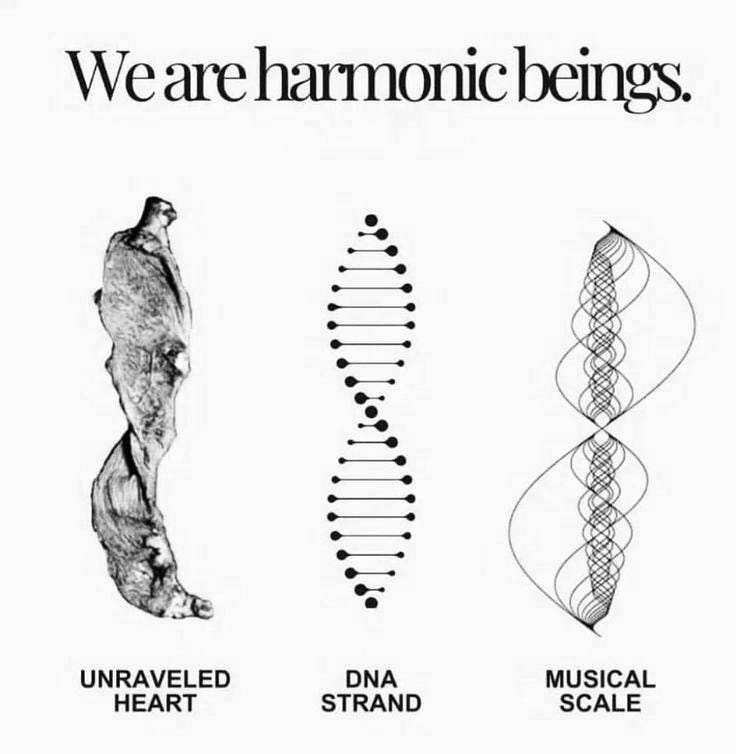
It’s hard not to notice how often the same shape appears once you start looking for it.
A galaxy turns. A storm organizes itself. A shell grows outward. Inside the body, DNA coils, proteins fold, the cochlea curls into itself, and even bone arranges microscopic fibers in subtle helices. The repetition feels almost intentional, as if the universe prefers this form.
But in living systems, the spiral isn’t an ornament or a hidden message, it’s more of a solution. Helical structures solve a set of challenges that show up again and again in nature: how to build something strong that can still move, how to store large amounts of information efficiently, how to grow without losing integrity, how to distribute stress so nothing fractures under pressure.
The spiral manages expansion and stability at the same time. It allows something to extend outward while remaining connected to its center.
That balance is what makes it so persistent across scales. Physics favors it. Biology refines it. Evolution keeps it because it works. And we, as organisms are shaped by those same constraints and so, we end up living inside that geometry.
Growth Is Rarely Linear
We often imagine change as a straight path — a clear progression from one state to another. But the nervous system doesn’t operate that way. Learning, adaptation, and emotional processing tend to move in loops. We revisit similar experiences, similar reactions, similar questions, yet each return carries a slight modification. It’s less like climbing a ladder and more like circling outward.
Neuroscience describes this through repetition with variation. Each time we practice a behavior or recall a memory, neural pathways are strengthened, weakened, or adjusted. The brain doesn’t overwrite itself all at once; it reshapes gradually, layering new responses onto old frameworks. Over time, those small shifts accumulate into something that feels like transformation.
The spiral is a surprisingly accurate metaphor for that process: you encounter familiar territory, but you’re no longer standing in exactly the same place.
Structure That Allows Flexibility
Look closely at where spirals appear in the body, and you’ll notice they often show up where resilience is required.
Collagen (one of the most abundant proteins we have) forms a triple helix. That arrangement gives tissues tensile strength while allowing movement. If it were rigid, we’d tear. If it were loose, we’d collapse. The spiral creates a middle ground: stability that can adapt.
The inner ear’s spiral shape allows us to detect a wide spectrum of sound frequencies within a compact space. DNA’s double helix protects genetic information while making it accessible enough to copy and repair. Even the way muscles wrap slightly around bones distributes force more evenly. These are not abstract symbols. They are mechanical strategies for surviving change.
And they hint at something fundamental:
life doesn’t endure by resisting motion. It endures by organizing motion.
Continuity Without Sameness
One reason the spiral resonates so strongly in human thought is that it captures a paradox we feel internally — the sense that we are continuous with who we’ve been, yet never exactly the same.
Cells replace themselves. Neural connections reorganize. Experiences alter perception. You are materially different from the person you were years ago, but there’s a recognizable through-line. The spiral embodies that idea: movement that preserves identity without freezing it.
It’s not about ascending to a final point. It’s about ongoing negotiation between what remains and what evolves.
A Pattern We Participate In
We are made from processes that follow universal constraints. The same physical laws shaping weather systems and galaxies also shape proteins and perception. The recurrence of the spiral is less a message and more a reminder that complexity everywhere faces similar problems and arrives at similar solutions.
We are not separate from those patterns. We are one localized expression of them, carrying out the same balancing act between order and change.
If the spiral tells us anything about being human, it might be this:
Progress is rarely straight.
Return does not mean failure.
Repetition can be the mechanism of transformation.
Stability and change are not opposites, they are intertwined.
The form that lets DNA replicate, bones bear weight, and galaxies rotate is also a useful way to understand how lives unfold. We circle, we adjust, we widen. We revisit what we thought we understood and find it altered by experience.
Not an ascent away from where we started, but an expansion that keeps us connected to it. And perhaps that’s why the shape feels so familiar when we notice it. We are already living inside its logic.
Inspired by a comment from @thecaseforus
The spiral captures something many people experience but struggle to explain: revisiting familiar places in life while carrying new capacity each time. The connection between biology and lived experience makes growth feel less like self-improvement and more like participation in a natural process.
Sounds like a song to be played. The harmonies of life, whatever tune you play it’s played in nature like music.