
The Earth’s Chakras
A Deeper Look at the Locations, Symbolism, and Why These Places Captured Human Attention

Recently I came across this diagram and found it intriguing.
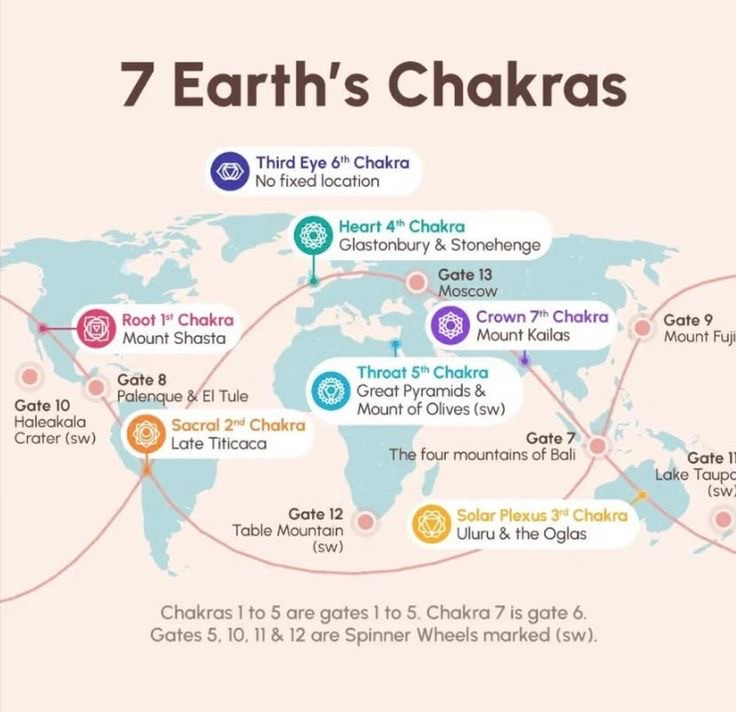
Whether viewed as sacred geography, energetic mythology, or symbolic psychology… one fascinating aspect of “Earth’s chakra systems” is that the locations themselves were not chosen randomly. Most of them carried spiritual significance long before anyone placed them on a global chakra map.
Human beings repeatedly traveled to these places long before airplanes, GPS, or social media existed.
Something kept drawing people there.
Root Chakra — Mount Shasta
Mount Shasta
The root chakra traditionally represents:
survival
safety
grounding
belonging
physical existence
Mount Shasta rises unexpectedly from Northern California like an isolated giant emerging from the Earth. It has long been considered sacred by Indigenous tribes including the Wintu, Modoc, and Shasta peoples.
Many stories describe it as a place where spiritual beings descended, where creation began, or where communication between worlds was thinner.
Modern spiritual communities often describe unusual experiences there:
heightened dreams, emotional shifts, powerful feelings of clarity, or a strange sense of “coming home.”
From a physical perspective, there may be reasons dramatic landscapes affect us deeply.
Large volcanic mountains create overwhelming sensory experiences:
altitude changes
silence
vast visual scale
altered oxygen levels
isolation from modern stimuli
The brain responds strongly to awe.
Neuroscience research suggests awe temporarily reduces self-focus and expands perception.
Interestingly, grounding itself is very much a root function:
When people feel psychologically untethered, they often seek forests, mountains, nature, and physical stillness.
Humans instinctively move toward “root-like” environments.

Sacral Chakra — Lake Titicaca
Lake Titicaca
The sacral chakra traditionally represents:
creativity
pleasure
emotion
sensuality
flow
Lake Titicaca is the highest navigable lake on Earth and was considered sacred by the Inca civilization. According to Incan cosmology, the creator deity emerged from these waters and brought forth the Sun.
Water symbolism here becomes almost impossible to ignore.
Across cultures, water repeatedly becomes associated with:
birth
emotional life
intuition
feminine energy
creation
Even neuroscience mirrors this metaphor in interesting ways.
Emotion itself behaves somewhat like water: Suppress it and pressure builds. Allow movement and adaptation occurs.
Lake environments also measurably affect nervous systems: Reduced stress hormones, increased parasympathetic activity, and enhanced calm are often associated with blue spaces.
Perhaps creativity and emotion became linked to water because humans repeatedly experienced this relationship.

Solar Plexus Chakra — Uluru and Kata Tjuta
Uluru
The solar plexus represents:
identity
confidence
willpower
personal power
Uluru rises from relatively flat desert surroundings as a massive sandstone monolith. For the Anangu people, this place is profoundly sacred and deeply intertwined with ancestral stories known as Dreaming. Many people describe standing before Uluru as emotionally overwhelming.
They describe it as very quiet. There is something psychologically interesting about open deserts. Without constant sensory stimulation, the brain sometimes shifts inward. Many meditation traditions intentionally reduce external distraction because internal awareness often becomes more noticeable in stillness.
The solar plexus concerns the question:
“Who am I?”
Deserts often ask that same question.
Remove enough noise and identity becomes harder to avoid.

Heart Chakra — Glastonbury and Stonehenge
Stonehenge, Glastonbury
The heart chakra represents:
love
connection
compassion
unity
This pairing is interesting because both locations are layered with mythology.
Glastonbury carries legends surrounding:
Avalon
the Holy Grail
mysticism
pilgrimage
Stonehenge remains one of humanity’s most enduring mysteries. People have gathered there for thousands of years. Pilgrimage itself may be important here. Love isn’t merely emotion. Love also creates movement toward something. Humans travel extraordinary distances for connection: to reunite with family, attend ceremonies, fall in love, or seek meaning.
Heart-centered locations repeatedly become gathering points.
They pull people toward each other.

Throat Chakra — Great Pyramids and Mount of Olives
Great Pyramid of Giza
Mount of Olives
The throat chakra represents:
expression
truth
communication
The symbolism becomes interesting here. The pyramids communicate across time. They are messages written in stone. Thousands of years later humanity still asks:
“Who built these?”
“How?”
“Why?”
Meanwhile the Mount of Olives carries profound significance in major religious traditions and has long been associated with teaching, prayer, and prophecy.
Speech is not simply words. Communication is transmission. Stories themselves become a form of energetic inheritance. Ideas survive longer than bodies.

Third Eye Chakra — No Fixed Location
The map labels this chakra as mobile.
The third eye traditionally represents:
intuition
perception
insight
inner vision
There is something almost poetic about the lack of fixed coordinates. Insight itself cannot be pinned down. Moments of sudden understanding happen: while driving, during dreams, while showering, while staring out airplane windows.
The brain’s default mode network—the network active during reflection and mind wandering—often becomes active during these seemingly ordinary moments. Many breakthroughs occur when people stop actively searching.
Perhaps intuition behaves similarly.
Crown Chakra — Mount Kailash
Mount Kailash
The crown chakra traditionally represents:
transcendence
spirituality
unity with something larger
Mount Kailash is considered sacred in multiple traditions including Hinduism, Buddhism, Jainism, and Bon.
Unlike many mountains, climbing it is generally prohibited. People circle the mountain rather than stand on top of it. That alone feels symbolic. Modern culture often treats spirituality as reaching the summit. Ancient traditions sometimes treated it differently: not conquering— circling. Listening. Witnessing.
The crown chakra concerns dissolving the illusion of separation and mountains often create that feeling naturally. Stand before something immense enough and personal problems sometimes shrink for a moment.
The boundary between self and everything else softens.

Whether Earth’s chakras are literal energetic nodes or symbolic mirrors of human psychology remains open to interpretation… but there is an intriguing pattern beneath all of this: Humans consistently returned to mountains, lakes, deserts, and stones long before satellites mapped the Earth.
Long before neuroscience. Long before modern spirituality.
Perhaps we were searching for something.
Or perhaps something in the landscape was quietly searching for us too.
Thanks for this Review. Chakras as "Energy Centres" around the Earth. Makes sense to me. After all Mother Earth is Alive. We all blossom because of Her. And surely, don't We need to take Better Care of Her???
Apparently they all moved because of some energetic work Robert Grant did in Scotland recently. I haven't looked into much but worth some research.